Some documents that those intending to purchase a property should ensure are in order.
A great deal of scrutiny is required before buying property. You should be diligent and check on the title of the property thoroughly. You should also check the mortgage status of the property. A clear title is also a pre-requisite for getting loans from banks or housing finance companies. In case the title of the seller is not clear, complications arising in future may be numerous. Banks will not provide loan for such a property. It will not be possible to re-sell the property too.
These documents and points should be kept in mind by a purchaser in order to minimise risks:
Conveyance or sale deed
This refers to the deed document by which the title of property is conveyed by the seller to the purchaser. Conveyance is the act of transferring ownership of the property from a seller to the buyer. This document helps the purchaser ascertain whether the property proposed to be bought is on the land belonging to the seller.
Search report and title certificate
A lawyer prepares the search/title report. This certificate is issued after conducting a search on the title of the property, which is intended to be purchased. The title certificate would state whether the property is unencumbered and has a clear marketable title. A search report on the title of a property is taken for the past 30 years. This document would state whether there is any existing mortgage, litigation, condition or claim, which is likely to affect the title of the buyer adversely. In case a buyer is intending to take a housing loan, the bank/housing finance company gets this report prepared.
Extract
This extract is issued by a Tahsildar or the land authorities concerned. It gives details of the property including survey numbers, location, area, date from which current owner is registered as owner etc.
Permission for non-agricultural use
This is very important. In case the land proposed to be bought is an agricultural land, and if one intends to develop the land for residential/commercial/industrial use, the land has to be first converted to non-agricultural land. In order to do so, a non-agriculture order has to be obtained from the District Collector in whose jurisdiction the property is located.
Along with this, one also needs the receipt for payment of non-agriculture tax. In cases where conversion from agricultural use to nonagriculture use is not done within the stipulated period, there should be an order from the authority concerned extending the period.
Sunday, April 13, 2008

Monday, April 7, 2008
Bagan: Myanmar city with 4 million Pagodas
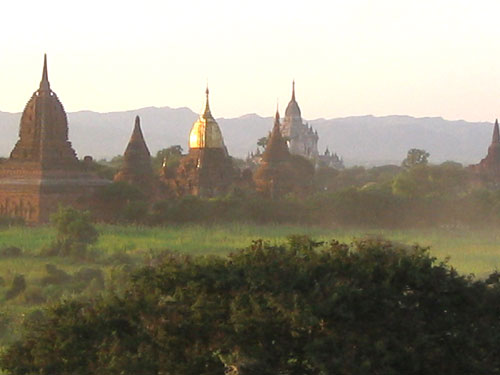
Bagan, a historic capital of Myanmar, known as the City of 4 Million Pagodas, is the richest archaeological site in Asia. It is in Bagan that Buddhism struck deep roots, and art and architecture attained peaks of achievement. Located some 300 miles from Yangon, Bagan stands on the east bank of the Ayeyawaddy, commanding the central plain of Myanmar in a setting which includes the great river flowing north to south and a network of paths and tracks. There are sandstone hills, an abundance of sand and river shingle, and a firm soil of stable bearing capacity. Bagan's climate is tropical and is generally hot and dry throughout the year. Winter time is ideal to visit as from November to February, day temperatures hover round 30°C and falls to 10°C at night. Rain is heavy and frequent between June and October. Its early history is unclear although chronicles relate that Bagan was formed from 19 villages. The most outstanding figure in its history is Anawrahta (1044-1077) who unified the country politically and culturally. He brought back to Bagan the Pali scriptures of Theravada Buddhism and set about building the awe-inspiring pagodas and temples which we still see today. His successors upheld this tradition for more than 290 years, covering an area of 16 sq miles with religious structures which number 2,217 in a recent list of the Department of Archaeology. Bagan's inscriptions mention congregation halls, ordination halls, libraries, monasteries and others, generally of timber or brick, occasionally of sandstone.
Subscribe to:
Posts (Atom)